NMEA 0183 (.nmea)
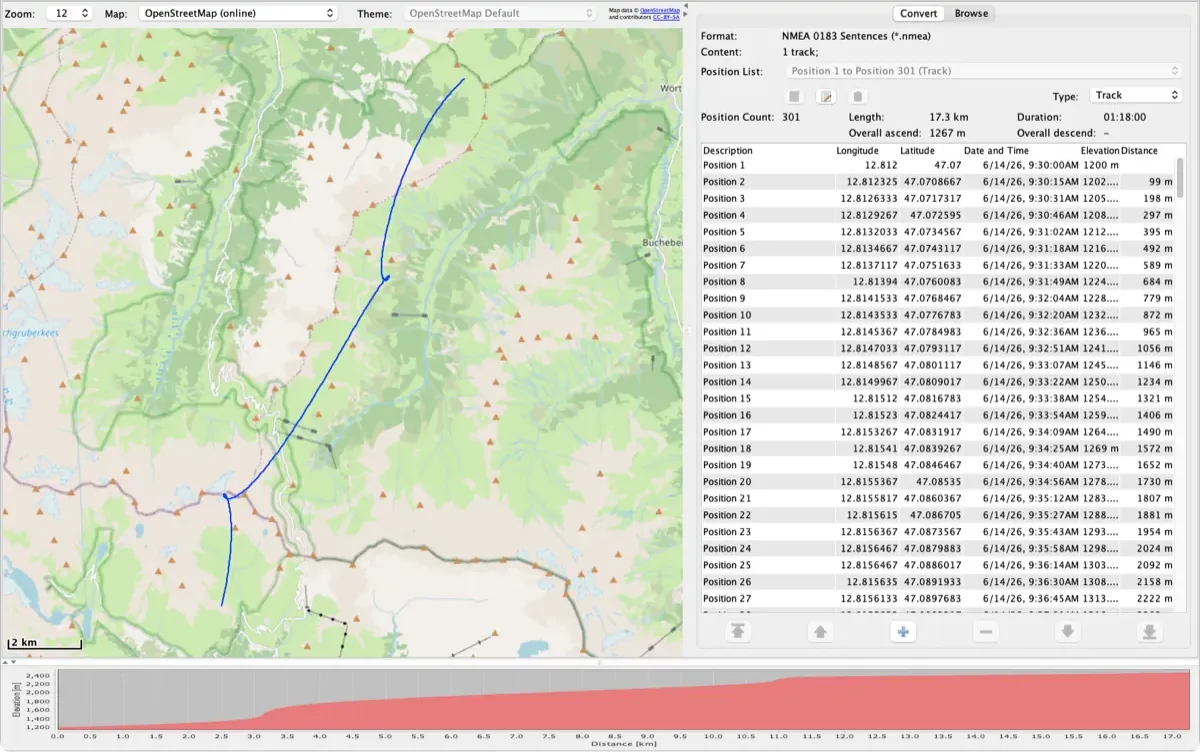
An NMEA file is a GPS track log: the NMEA 0183 text sentences a GPS receiver speaks over its serial line, saved to disk line by line, usually as .nmea, .txt or .log. NMEA 0183 is not really a file format but that stream, so almost anything can read the log: a text editor shows the raw sentences, and RouteConverter shows the track on the map and converts it to GPX, KML or an Excel spreadsheet.
At a glance
| Extension | .nmea |
| Encoding | text |
| Invented | 1983 |
| By | National Marine Electronics Association (NMEA) |
| Current version | 4.30, published December 2023 |
History
The National Marine Electronics Association defined NMEA 0183 in 1983, replacing its earlier NMEA 0180 and 0182 standards. It has been revised many times since; version 4.30 was published in December 2023. NMEA 2000 has largely taken over in leisure boating, but NMEA 0183 remains the norm in commercial shipping and is still what a bare GPS chip emits.
Where it is used
Marine GPS units, chartplotters, AIS transponders, USB GPS receivers and basic data loggers all speak NMEA 0183. Almost any software that talks to a GPS receiver directly — navigation programs, aviation tools, radiosonde trackers — parses it. Data loggers, USB receivers and GPS logging apps save the stream to a file; the extension varies (.nmea, .txt, .log), the content is the same.
Structure
NMEA 0183 is plain printable ASCII carried over a serial line, classically at 8-N-1 and 4800 baud (38400 for the high-speed AIS variant). Each sentence starts with $ or !, then a two-character talker ID and a three-character sentence type, then comma-separated fields, then an asterisk and a two-digit hexadecimal checksum, and ends with carriage return and line feed; a sentence is at most 82 characters. A typical line reads $GPRMC,093015.00,A,5122.3810,N,00658.7240,E,0.4,87.3,140526,,,A*68: talker GP (GPS) and sentence type RMC, UTC time 09:30:15, status A (valid fix), latitude 51° 22.3810′ N and longitude 6° 58.7240′ E (degrees and decimal minutes, not decimal degrees), speed over ground 0.4 knots, course 87.3°, date 14 May 2026, two empty magnetic-variation fields, mode A (autonomous fix) and checksum 68. For GPS the sentences that matter are GGA (fix, time and altitude), RMC (the recommended minimum of position, speed and date), GSA (fix mode and dilution of precision) and GSV (satellites in view).
How widespread
NMEA 0183 is the lowest common denominator of satellite navigation: no route structure, no metadata, no nesting — just position fixes over time. That makes it universally readable and a poor choice for anything you want to plan rather than record.
RouteConverter support
| Reads | NMEA 0183 Sentences |
| Writes | NMEA 0183 Sentences |
RouteConverter reads the RMC, GGA, GLL, GNS, VTG, ZDA, GSA and WPL sentences of GPS ($GP) and multi-constellation ($GN) receivers, whatever the extension — .nmea, .txt or .log — and builds a track with time, position, elevation, speed, course, satellite count and dilution of precision. Lines with a wrong checksum or without a fix are skipped. To get the log into a spreadsheet, open it via File → Open and save it as Microsoft Excel via File → Save as (NMEA to Excel); for maps and other apps, save it as GPX (NMEA to GPX). RouteConverter writes NMEA 0183 as well.
Specifications and documentation
Related conversions
FAQ
What is a .nmea file?
An NMEA file is a GPS track log: the NMEA 0183 text sentences a GPS receiver speaks over its serial line, saved to disk line by line, usually as .nmea, .txt or .log. NMEA 0183 is not really a file format but that stream, so almost anything can read the log: a text editor shows the raw sentences, and RouteConverter shows the track on the map and converts it to GPX, KML or an Excel spreadsheet.
How do I open a .nmea file?
RouteConverter, the free converter for Windows, macOS and Linux, opens NMEA 0183 files: start the app, load the file, then view it on the map or save it in another format.
What can I convert .nmea to?
RouteConverter turns .nmea files into other formats, free. These conversions have their own guide: NMEA 0183 to Microsoft Excel, NMEA 0183 to GPX.